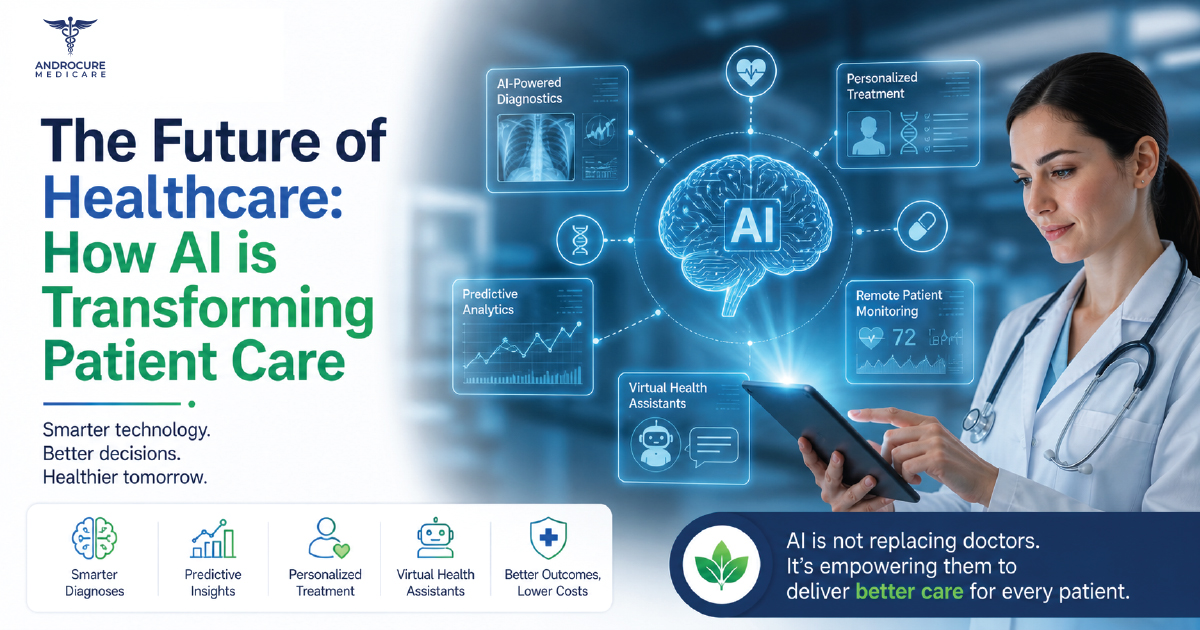
Artificial Intelligence (AI) is rapidly transforming the healthcare industry across the globe. From faster diagnosis and smarter treatment planning to virtual healthcare assistance and predictive analytics, AI is helping medical professionals improve patient care like never before.
As healthcare continues to evolve digitally, AI-powered technologies are becoming essential tools for hospitals, pharmaceutical companies, healthcare providers, and patients.
At Androcure Medicare, we believe innovation and technology are shaping the future of modern healthcare. In this blog, we explore how Artificial Intelligence is revolutionizing patient care and improving healthcare systems worldwide.
Artificial Intelligence in healthcare refers to the use of advanced computer systems and algorithms that can:
AI technologies can process large amounts of healthcare information much faster than traditional systems, helping doctors make informed decisions efficiently.
How AI is Transforming Patient Care
1. Faster and More Accurate Disease Diagnosis
AI-powered systems can analyze:
These systems help healthcare professionals detect diseases earlier and with improved accuracy.
AI is increasingly being used for identifying:
Early diagnosis can significantly improve treatment outcomes and patient survival rates.
2. Personalized Treatment Plans
Every patient responds differently to treatment. AI helps create personalized healthcare solutions by analyzing:
This allows doctors to recommend customized treatments that may improve effectiveness and reduce side effects.
Personalized medicine is becoming one of the biggest advancements in modern healthcare.
3. AI-Powered Virtual Health Assistants
Virtual healthcare assistants and AI chatbots are improving patient engagement by:
These tools help reduce the workload on healthcare staff while improving patient convenience.
4. Improved Drug Discovery and Development
Developing new medicines traditionally takes years of research and testing. AI is helping pharmaceutical companies speed up this process by:
This can reduce research time and help bring innovative medicines to patients faster.
At Androcure Medicare, innovation-driven pharmaceutical development remains an important part of future healthcare advancement.
5. Predictive Healthcare and Disease Prevention
AI can analyze large healthcare datasets to predict potential health risks before symptoms become severe.
Predictive healthcare may help identify:
Preventive healthcare supported by AI can improve long-term patient outcomes and reduce healthcare costs.
6. Enhanced Medical Imaging
AI-based imaging systems can help radiologists detect abnormalities with greater precision.
These technologies assist in:
Medical imaging powered by AI improves diagnostic speed and reduces the chances of human error.
7. Remote Patient Monitoring
Wearable devices and AI monitoring systems allow healthcare providers to track patient health remotely.
AI can monitor:
This technology is especially useful for elderly patients and individuals with chronic diseases.
Remote healthcare monitoring supports faster medical intervention when necessary.
Benefits of AI in Healthcare
Improved Efficiency
AI automates repetitive healthcare tasks, saving time for doctors and medical staff.
Better Patient Outcomes
Early diagnosis and personalized treatments improve healthcare quality and recovery rates.
Reduced Human Errors
AI systems assist healthcare professionals with data analysis and decision-making.
Faster Medical Research
AI accelerates pharmaceutical and clinical research processes.
Cost Optimization
Automation and predictive analytics help reduce unnecessary healthcare expenses.
Challenges of AI in Healthcare
While AI offers many advantages, there are still challenges that need attention:
AI should support healthcare professionals, not replace human medical expertise.
The Future of AI in Healthcare
The future of healthcare will likely become more:
AI may continue transforming:
As technology advances, AI will play a major role in making healthcare more accessible, accurate, and efficient.
Why Healthcare Innovation Matters
Healthcare innovation improves:
Companies focused on pharmaceutical and healthcare advancement contribute significantly to building a healthier future.
At Androcure Medicare, we support innovation, quality healthcare awareness, and modern pharmaceutical solutions that contribute to better patient care.
Conclusion
Artificial Intelligence is reshaping the future of healthcare by improving diagnosis, treatment planning, patient monitoring, and medical research. As AI technologies continue evolving, healthcare systems around the world may become faster, smarter, and more patient-focused.
Although challenges remain, the combination of medical expertise and AI-driven innovation has the potential to revolutionize patient care and improve global health outcomes.
The future of healthcare is not just digital - it is intelligent.

Androcure has a commitment to mankind, a commitment of improving the quality of life
Read More